

Kinsale is rich in history and historical sites. Like many parts of Ireland the origins of this southerly port town can be traced back to early monastic settlements in the 6th century. But the first signs of growth as a trading town began around the 10th century when invading Vikings formed a trading post there. The combination of fertile land and rich fisheries meant that Kinsale became a very attractive settlement for the invading Anglo-Normans. Around the 13th Century they had claimed the area from the local Irish clans and turned Kinsale into a medieval walled town.
By forging strong trade connections with England and the European mainland, Kinsale became a focal point of wine trade and was officially known as a dedicated “Wine Port”. These strong ties led to Kinsale’s colonisation by England, which was confirmed by a Charter by King Edward III in 1333. At this point Kinsale had already established itself as a booming port town.
Kinsale has many historical sites available across the town. Kinsale is steeped in history and not short of things to do for history fanatics. From breathtaking forts and castles dating back to the 16th century, to its growth from a port town to a bustling tourism hub, Kinsale has a varied and interesting past. Many of the historical sites of Kinsale can be discovered at virtually no cost.
Battle of Kinsale
Famously in 1601 Kinsale became the battle site and pivotal part in Irish history, and the end of the old way of life in Ireland as we know it. On December 24, 1601 the battle was fought between approximately 5,500 Irish troops and English either side. The battle itself took place about 4 miles northwest of the town. The weapons used in the battle would have been swords, haliberds, firearms and pikes. The battle of Kinsale was over within a few hours with victory won by the English who claimed to have killed over 1,000 Irish and Spanish soldiers while suffering relatively few casualties themselves. At the site of the battle there now sits a monument commemorating the event, an empty chair that symbolises the loss of life.
Charles Fort
As far as historical sites of Kinsale go, Charles Fort is probably the best known and for good reason. Charles Fort is on the road just beyond Summercove. It is open all year, and regular guided tours are available. Charles Fort is one of the finest surviving examples of a 17th Century star-shaped fort, and much of the construction begun in 1678 remains. The fort has two enormous bastions overlooking the estuary, and three facing inland. Within its walls were all the barracks and ancillary facilities to support the fort’s garrison.
James Fort
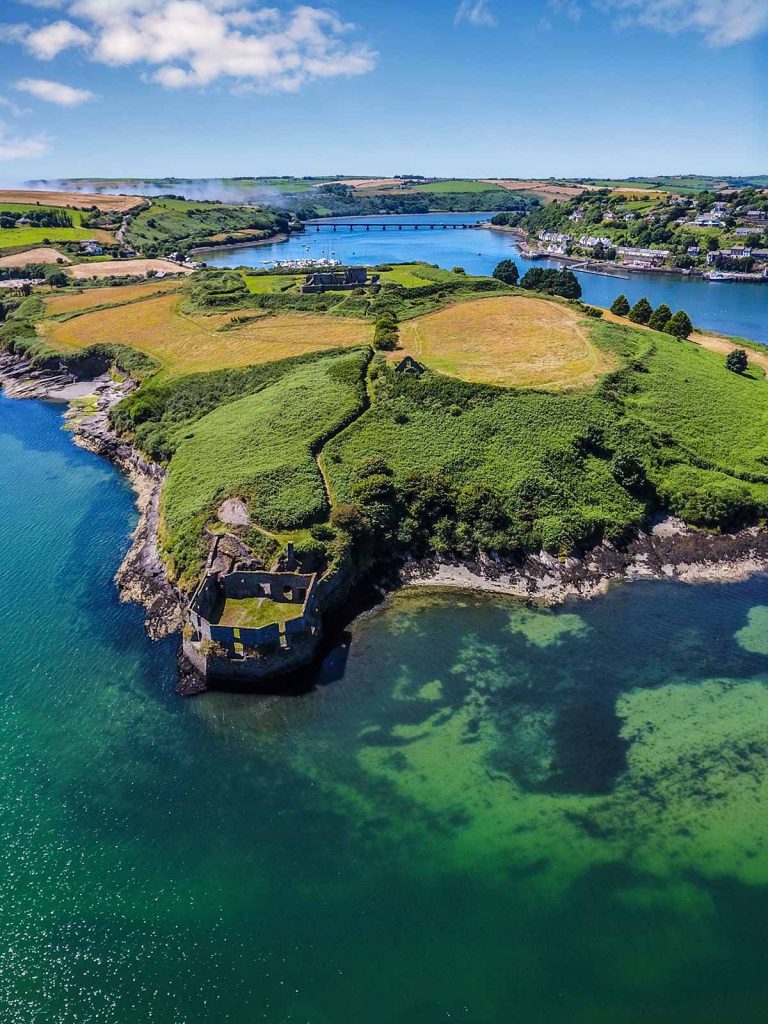
Built in 1607, this historical fort was a key feature of Kinsale’s defences. It is located directly across the harbour from Charles Fort, which was used to the advantage of defending forces when protecting against sea based attacks.
James Fort is located on the Castlepark peninsula and beside the Dock Beach. Found on a grassy headland, James Fort is the perfect setting for a walk through history and is free of charge all year round.

St. Multose Church
This historic church is one of the most important landmark buildings in Kinsale’s history. Originally built in 1190, this church has undergone various improvements and additions throughout its 800 year history. St. Multose Church is thought to be one of the oldest standing churches in Ireland. To this day, St. Multose Church continues to be used as a place of worship in Kinsale. Although some parts of the church have undergone changes and upgrades since the medieval times, many of the original features from 1190 are still present today.
The historical site of Kinsale is located in the town centre along with a historic graveyard within the same walls where three of the Lusitania victims are buried.
Desmond Castle
Built as an urban tower house by the Earl of Desmond c. 1500, Desmond Castle has served as Customs House, Prison, Ordnance store and a Workhouse.
Desmond Castle was built in about 1500 by Maurice Bacach Fitzgerald, Earl of Desmond. It has had many uses. In 1600 and 1601 it was used as an arsenal by Don Juan Aguilla during the Spanish occupation of the town which lasted for 100 days prior to the Battle of Kinsale in 1601. American privateers were also confined here during the American War of Independence

Courthouse and Regional Museum
This interesting building was built about 1600, with additions in 1706 that included the frontage with the loggia on the ground floor. The courthouse was used for the inquest into the sinking of the liner Lusitania on Monday May 10th 1915.
The main structure can be dated back as far as the 1590’s, town records showing its primary function having been that of a market house. Meanwhile, the elegant facade was added in 1703 and is Dutch in style. One of the features of note is the Venetian window above the entrance, a very rare and unusual example in this country.
Giant of Kinsale – Patrick Cotter O’Brien
He took the O’Brien name to bolster a claim that he was a direct descendant of Brian Boru. The best estimate of his unusual height is a staggering 8’-1”. He died aged 46, which was above average for that time. He was wealthy with property in England and Ireland.
Garden of Remembrance
The Garden of Remembrance was established by a Kinsale lady, Kathleen Cait Murphy who worked as a nurse for over 30 years in New York City. During that time she came to admire the work of the fireman and was shocked at the deaths of 343 of their number who died in 9/11. As a result, she decided to provide a memorial in Ireland, on her land at Ringfinnan, Kinsale, with a tree for each of the firemen who died as well as one for their chaplain Father Michael Judge who was a personal friend of hers.
Lusitania Museum & Signal Tower
The Old Head of Kinsale Signal Tower is a beautifully restored viewing point and museum on the iconic Wild Atlantic Way in Co. Cork. Open Daily from 10am.
The signal tower which was originally built 200 years ago has been restored to tell two very different stories. On the ground floor it gives the history of this and other Irish signal towers and on the first floor tells the history of the sinking of the RMS Lusitania, which was torpedoed during WW1 by a German U-boat on May 7th 1915 resulting in immense loss in life.


Follow Us